
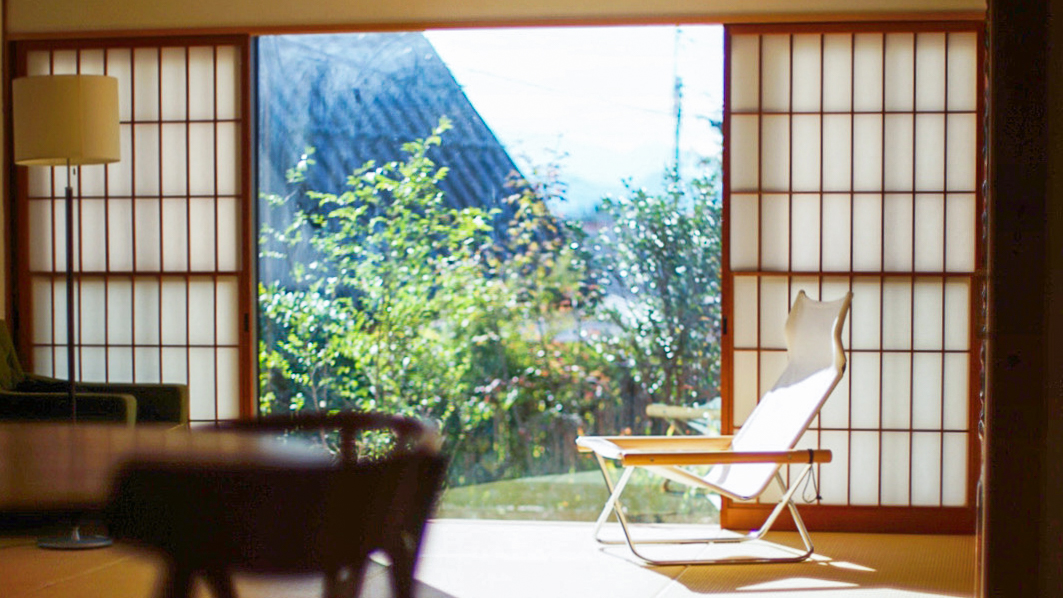
建築の空間は、単に壁や床で囲われた器ではない。そこには、家族の距離感や生活のリズムといった要素の関係性が組み込まれている。プランや寸法、光の射し方は、人がどこに佇み、どこで集まり、どこで一人になるかといった「居場所の原形」を形づくっている。
しかし、いかに建築が綿密に計画されていても、それだけで人が居場所を感じるわけではない。建築と人間のあいだには、もうひとつ関係を媒介する存在が必要であり、それが家具である。
家具は、建築に潜在する居場所を可視化し、人と空間とを仲介する。たとえば、何もない空間に椅子が一脚置かれただけで、その周囲には明確な「場」が生まれる。座る、向き合う、寄りかかるといった行為が誘発され、人の振る舞いが変わる。椅子の向きや高さ、素材の手触りは、そこにいる人の姿勢や心のありようだけでなく、家族どうしの関係性にさえ影響を与える。家具は、建築の抽象的な空間に具体的な生活の解像度を与え、暮らしの風景を顕在化させる。
人間は複数の層に包まれて生きている。もっとも肌に近いのが衣服であり、その外側に建築がある。さらに広く敷地環境があり、最も外側には自然がある。もし人が何も身につけず、建物にも守られず、自然の中に裸で立てば、その環境に抗うことはできない。衣服と建築の役割は身体を守り、生活を成立させることであるが、家具はその中間にあって、人が空間と関わるための「第二の皮膚」のような層をつくりだす。
ソファは身体を預ける柔らかな器であり、椅子は集中する姿勢を形づくる道具である。テーブルは食事や仕事を支え、その周囲に人を集める重心となる。家具は身体に直接触れることで、建築という大きな器のスケールを人の身体に合わせて調整し、空間と自分との距離を測る指標となる。
住宅を体感するとき、立って見回すだけではその半分も理解できない。実際の暮らしの多くは、椅子に座ったり、ソファで寛いだりする「座る姿勢」で営まれているからである。家具に身を預けたとき、視線の高さや身体の方向、外との距離感が変わり、空間の感じ方そのものが大きく変化する。家具を通してはじめて、人はどこが落ち着く場所なのか、どこに自分の居場所があるのかを自然と見いだすことができる。
家具が衣服についで肌に近い存在であることは、素材の重要性とも深く関わる。木の椅子やテーブルは、年月を重ねるほどに色つやが増し、手触りは変化し、生活の痕跡を受け入れていく。人工的に均質化された素材では得がたい「時間の厚み」がそこには宿る。自然素材の家具が人の生活と親和性が高いのは、単なる個人的な好みを越えて、その素材が人の身体感覚に適合するからである。
私が住宅のプランを思案するとき、常に意識するのは「どこに座れば気持ちがよくなるか」ということである。視線の抜け、光の入り方、風の流れ──それらはすべて“座る位置”によって変わる。ピクチャーウィンドウを考えるときも、同時に「その窓をどこから、どの高さから、どんな姿勢で見るのか」を想像する。ただ大きな窓をつくれば良いわけではない。窓辺に腰かけたときに、ちょうど良い量の景色が切り取られ、光が差し込み、外との距離感が心地よく感じられるかどうかが肝要である。つまり、家具の位置や使われ方を想像することが、建築の要素そのものを決定する契機になる。家具は、建築の内側から空間を形づくる“媒介”としても働くのである。
健康なときに自分の健康を意識しないように、よい家具は使っているあいだ、その存在を強く主張しない。派手ではなく、静かに空間を整え、身体を支え、居場所をそっと示す。家具とは、建築と人間のあいだに置かれた「もうひとつの層」であり、人の生活を媒介する欠かせない存在なのである。
Architecture is not merely a container defined by walls and floors. It embeds within it the relationships among elements such as the distance between family members and the rhythms of daily life. The plan, the dimensions, and the way light enters shape the primordial structure of “places to be”—where one stands, gathers, or withdraws to be alone.
Yet no matter how meticulously architecture is designed, that alone does not create a true sense of place. Between architecture and the human body, another mediating presence is required, and that presence is furniture.
Furniture makes the latent places within architecture visible and mediates between people and space. For example, placing a single chair in an empty room immediately brings a “place” into existence. Sitting, facing, leaning—such actions are prompted, and one’s behavior subtly shifts. The orientation and height of the chair, its tactile qualities—these influence not only posture and emotional disposition but also the relationships among family members. Furniture gives concrete resolution to the abstract space of architecture and brings everyday scenes into focus.
Human beings live enveloped by several layers. Closest to the skin is clothing; outside that is the building; beyond that lies the site and, ultimately, nature. If a person stood naked in nature without clothing or shelter, they would be unable to resist the conditions around them. While clothing and architecture function to protect the body and sustain life, furniture exists in the intermediate layer, forming a “second skin” that enables us to engage with space.
A sofa is a vessel that receives the body; a chair is a tool that forms a posture for concentration. A table supports eating and working and becomes a gravitational center that draws people around it. By touching the body directly, furniture adjusts the scale of the architectural container to human proportions, becoming a reference for measuring one’s distance to space.
When experiencing a house, simply walking through it while standing reveals only half of what the house truly offers. This is because most of life unfolds in a sitting posture—on chairs, on sofas, in moments of rest. Once the body is placed in furniture, the height of the gaze, the direction of the body, and the sense of distance to the outside all change. The perception of space itself transforms. Only through furniture can one naturally discover where one feels at ease and where one’s place truly lies.
That furniture is second only to clothing in its proximity to the body underscores the importance of materials. Wooden chairs and tables gain luster over time, their surfaces soften, and they accept the traces of life. They accumulate a depth of time that uniform, synthetic materials cannot offer. Natural materials harmonize with human life not merely as a matter of taste but because they suit the sensory qualities of the human body.
When I design a floor plan, I am always conscious of “where one would feel good sitting.” The direction of the gaze, the quality of light, the movement of air—all shift depending on that seated position. When considering a picture window, I simultaneously imagine “from where, at what height, and in what posture” it will be viewed. A large window is not inherently better; what matters is whether sitting by the window allows the right portion of the landscape to be framed, the right amount of light to enter, and a comfortable sense of distance to be felt. Imagining how furniture will be placed and used becomes a critical factor in shaping the architectural elements themselves. Furniture functions as a mediator that forms space from within.
Like health that goes unnoticed when one is well, good furniture does not insist on its presence while in use. Quiet rather than showy, it organizes the space, supports the body, and gently indicates where one may dwell. Furniture is a “layer” placed between architecture and the human being—an indispensable mediator of daily life.