
建築に進もうと思ったとき、最初に知ったのは、いわゆる近代建築の三人の巨匠であった。
ル・コルビュジエ、ルートヴィヒ・ミース・ファン・デル・ローエ、そして フランク・ロイド・ライト である。
当時、特に魅力的に感じたのはフランク・ロイド・ライトであった。
建築を学び始めたばかりの頃は、写真や図面を眺めながら、漠然と建築を追いかけていたにすぎない。写真から伝わってくる力強さや、どこか心地よさそうな雰囲気を、理由も分からないまま感じ取っていたのだと思う。
三人の巨匠には、それぞれ代表的な住宅作品がある。
コルビュジエの サヴォア邸、ミースの ファンズワース邸、そしてライトの 落水荘 である。
滝の上に建つ落水荘の姿を知ったとき、建築の可能性や面白さを強く感じた。
形の強さや構成の明快さ、写真からでも伝わってくる建築そのもののエネルギーに、ただ圧倒されていたのだと思う。
それでも今振り返ると、ライトの建築に惹かれていた理由は、単なる造形の魅力だけではなかった。ライトの建築には、どこに立ち、どこに留まり、どこを通り抜けるのかが、言葉で説明される前に、身体で理解できるような感覚がある。空間が人の動きを導き、無意識のうちに居場所が定まっていく。その在り方は、後になって「居場所」や「余白」といった言葉で今考えていることと、どこかでつながっているように感じている。
学生の頃は、そのことをうまく言語化できなかった。ただ、平面図や写真を眺めているだけで、あたかも空間の中を歩いているかのような感覚があり、それが心地よかった。
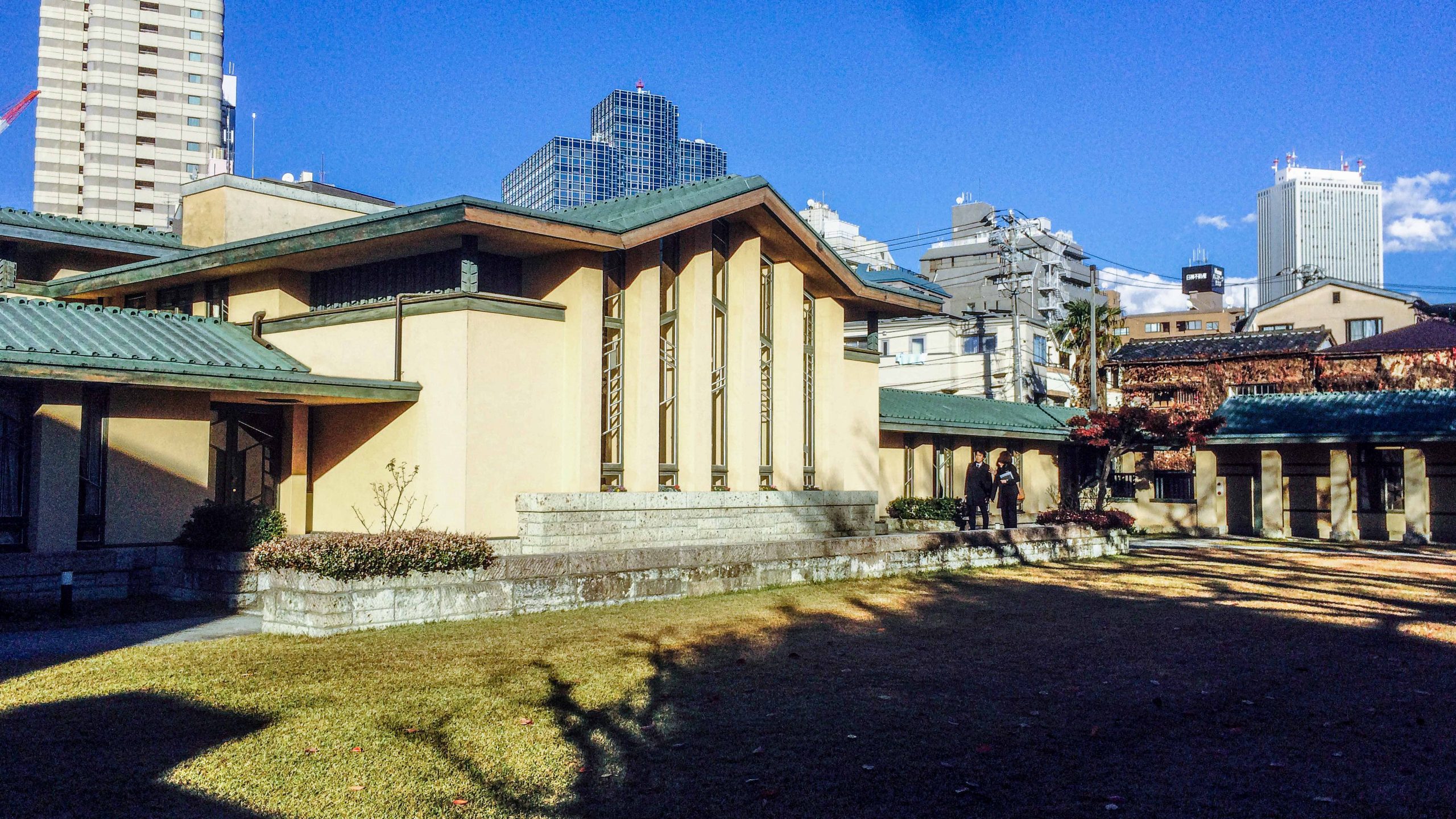
ライトの建築は日本にもいくつか残されているが、その中でも池袋にある 自由学園明日館 には、何度も足を運んだ。街の中を歩いていると、ぽっかりと空いた広場とともに、左右対称の端正な建築が突然あらわれる。
完全な洋風でもなく、どこか和を感じさせるプロポーションを持っている。写真で見る印象よりも、実際の建築はずっと小さい。しかし、窮屈さはまったく感じない。その場に身を置くと、不思議と長く居てしまう。全体として、居心地の良さがそこかしこにある。
特にその要因は、スケールとプロポーションにあるのではないかと思う。天井の高さ、リズミカルな柱、窓の位置、廊下の幅。そのどれもが大きすぎず、小さすぎず、身体の感覚と無理なく重なっている。建築が人を圧倒するのではなく、人の存在を素直に受け止めてくれるような寸法感覚がある。
自由学園の心地よさは、造形や様式以前に、人の身体を基準にした空間の組み立てにあったのだと思う。そこには、「ここが居場所です」と示されるような強い演出はない。けれども、自然と立ち止まり、腰を下ろし、視線が落ち着く場所が点在している。その連なりが、建築全体の居心地をつくっている。
自由学園の空間には、遊び心のある装飾が散りばめられている。それらは決して過剰ではないが、空間にリズムを与え、建築に自由さを感じさせる要素として確かに機能している。
私が建築を学んでいた頃、装飾的なものは、あまり肯定的に語られていなかったように思う。機能や構造、合理性が重視され、装飾はどこか恣意的で説明しにくいものとして距離を置かれていた。装飾はインテリアの範囲に留まり、建築とは別のカテゴリとして扱われていた感覚があった。
そのなかにあって、自由学園で感じた魅力は、空間と装飾が分離されていない点にある。装飾が後から付け加えられているのではなく、空間の構成そのものと結びつき、ひとつの居場所として成立している。視線の抜けや身体の居どころと装飾が重なり合い、そこで過ごす時間そのものを支えているように感じられた。
装飾は、単なる意匠ではなく、空間の性格を構成する要素になりうる。そのことを、自由学園の建築は身体的に教えてくれたように思う。
When I first decided to pursue architecture, the names I encountered were those of the so-called three masters of modern architecture:
Le Corbusier, Ludwig Mies van der Rohe, and Frank Lloyd Wright.
Among them, the one who captivated me most at the time was Frank Lloyd Wright.
When I had just begun studying architecture, I was merely following it in a vague way, looking at photographs and drawings. I did not yet have the language to explain what I was seeing; I simply sensed the power conveyed through images, and the atmosphere that felt somehow comfortable, without knowing exactly why.
Each of the three masters has a representative residential work.
Le Corbusier’s Villa Savoye, Mies’s Farnsworth House, and Wright’s Fallingwater.
When I first learned of Fallingwater, built directly over a waterfall, I strongly felt the possibilities and the sheer fascination of architecture. I think I was overwhelmed by the strength of its form, the clarity of its composition, and the energy of the building itself—an energy that could be felt even through photographs.
Yet looking back now, I realize that what drew me to Wright’s architecture was not simply its formal appeal.
In Wright’s buildings, there is a bodily clarity that precedes verbal explanation: one intuitively understands where to stand, where to pause, and where to move through. Space guides human movement, and places to dwell emerge unconsciously. This way of shaping space feels deeply connected to the ideas I now think about using words such as “place” and “spatial margin.”
As a student, I could not articulate this clearly.
Still, simply looking at plans and photographs gave me the sensation of walking through the space itself, and that feeling was deeply comforting.
Several of Wright’s buildings remain in Japan, and among them, I visited Jiyu Gakuen Myonichikan in Ikebukuro many times. Walking through the city, one suddenly encounters a symmetrical, composed building accompanied by an open courtyard, appearing almost unexpectedly.
It is not entirely Western in character; its proportions carry a subtle sense of something Japanese. Seen in photographs, it appears larger than it actually is. In reality, the building feels much smaller—yet never cramped. When you place yourself within the space, you find yourself lingering without noticing. A sense of comfort is present everywhere.
I believe this is largely due to its scale and proportions.
The ceiling heights, the rhythmic spacing of the columns, the placement of windows, the width of the corridors—none of these elements are too large or too small. They align naturally with the scale of the human body. Rather than overwhelming the occupant, the architecture seems to accept human presence with quiet generosity.
The comfort of Jiyu Gakuen lies not in its form or style, but in a spatial composition grounded in the human body. There is no strong gesture that declares, “This is the place to be.” And yet, there are many points where one naturally stops, sits down, and lets one’s gaze settle. The accumulation of these moments creates the overall sense of comfort in the building.
The spaces of Jiyu Gakuen are also enriched by playful decorative elements.
They are never excessive, but they introduce rhythm into the space and function as elements that lend the architecture a sense of freedom.
When I was studying architecture, decoration was rarely spoken of positively. Function, structure, and rationality were prioritized, while decoration was seen as arbitrary—something difficult to justify—and was therefore kept at a distance. Decoration seemed confined to the realm of interior design, treated as separate from architecture itself.
Against this backdrop, what I found compelling about Jiyu Gakuen was the fact that space and decoration are not separated. The decorative elements are not added afterward; they are inseparable from the spatial composition, forming places in their own right. Sightlines, bodily positioning, and decoration overlap, quietly supporting the experience of time spent there.
Decoration, then, is not merely an ornamental gesture, but an element that helps shape the character of space itself.
This is something that the architecture of Jiyu Gakuen taught me—not intellectually, but through the body.